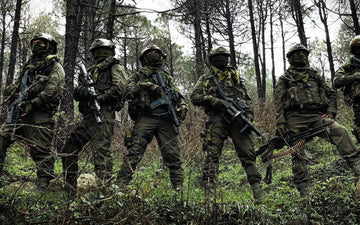
The 1 Para Special Forces, commonly referred to as 1 Para SF, stands as one of the oldest and most distinguished units within the Indian Army’s Parachute Regiment. Renowned for its exceptional operational effectiveness, the battalion specialises in counter-terrorism, special operations, and high-risk missions that demand precision, stealth, and unyielding resolve. As a cornerstone of India’s special operations capability, 1 Para SF has earned a formidable reputation through decades of service, embodying the highest standards of professionalism and combat readiness in the Indian Army. Its operators are trained to execute complex tasks in diverse environments, from mountainous terrain to urban settings, often under conditions that test the limits of human endurance.
History and Formation
The origins of 1 Para SF trace back to the early history of the Indian Army’s parachute forces, rooted in the 50th Indian Parachute Brigade formed during the Second World War in October 1941 under British Indian Army command. Following India’s independence, the restructured 50th Parachute Brigade retained three elite battalions personally selected by the Commander-in-Chief: 1 PARA from the Punjab Regiment, 2 PARA from the Maratha Light Infantry, and 3 PARA from the Kumaon Regiment. The 1st Battalion itself carries a lineage dating to 1761 as part of the 2nd Punjab Regiment, reflecting a long tradition of distinguished service.
In the immediate post-independence period, 1 PARA participated actively in major conflicts. During the 1947-48 Indo-Pakistani War, the unit contributed to operations in Jammu and Kashmir. Its pivotal role emerged prominently in the 1965 Indo-Pakistani War, where 1 PARA, operating under the 68th Infantry Brigade, played a decisive part in the capture of the strategically vital Haji Pir Pass. Under the leadership of Major Ranjit Singh Dayal, the battalion executed a series of daring assaults, securing features such as Sank, Ser, and Ledwali Gali before capturing the pass itself on 28 August 1965. This operation, conducted in challenging high-altitude terrain, earned the unit the Battle Honour ‘Hajipir’ and the Theatre Honour ‘Jammu & Kashmir’.

The transformation of 1 PARA into a Special Forces unit occurred in 1978, marking a significant milestone in the evolution of Indian Army special operations. As an experimental initiative, the battalion was converted to become the first dedicated Special Forces formation in the Indian Army, serving initially as a tactical reserve. This conversion built upon the broader development of parachute commando capabilities initiated after the 1965 war, though 1 PARA’s shift to the Special Forces role distinguished it within the regiment. The unit’s pre-existing combat experience and high standards of training facilitated its seamless adaptation to specialised missions. Subsequent involvement in operations, including deployment with the Indian Peace Keeping Force in Sri Lanka during the late 1980s, further honed its capabilities in unconventional warfare and counter-insurgency environments.
Also Read: All You Need to Know About 9 Para Special Forces (9 Para SF) – India’s Elite “Pirates”
Roles and Responsibilities
The core mandate of 1 Para SF encompasses a wide spectrum of special operations tailored to contemporary security challenges. Primary responsibilities include counter-terrorism and counter-insurgency missions, where the unit conducts precise strikes against terrorist networks and insurgent elements. Direct action operations, such as surgical raids and ambushes, form another key pillar, enabling the rapid neutralisation of high-value targets with minimal collateral impact. Special reconnaissance remains central, involving deep infiltration to gather intelligence in hostile territories, often ahead of larger conventional forces.
Hostage rescue operations demand the unit’s expertise in close-quarters combat and rapid intervention, while unconventional warfare tasks focus on supporting indigenous resistance or disrupting enemy logistics behind lines. These roles are executed primarily by small, highly cohesive teams of multi-skilled operators who possess proficiency across multiple disciplines, including weapons handling, demolitions, communications, and medical aid. This team-based structure ensures flexibility and autonomy, allowing 1 Para SF personnel to operate independently in austere conditions while maintaining seamless coordination with supporting elements when required. The unit’s emphasis on versatility enables it to adapt swiftly to evolving threats across varied operational theatres.
Training and Selection
Entry into 1 Para SF demands an extraordinarily rigorous selection and training process, widely regarded as one of the most demanding in the Indian Army. Volunteers, typically drawn from across the Army after completing basic military training, must first qualify as paratroopers. This begins with the Basic Parachute Course at the Parachute Training School in Agra, involving a series of static-line jumps, including a mandatory night jump, to earn the coveted maroon beret.
The subsequent probation phase for Special Forces selection extends over several months and is characterised by an attrition rate often exceeding 80 per cent. Probationers endure extreme physical and mental stressors designed to identify individuals capable of operating under prolonged duress. Key elements include long-distance marches with heavy loads across demanding terrain, sleep deprivation exercises, and survival training in isolated environments. These tests assess not only endurance but also decision-making, resilience, and psychological fortitude. Candidates may voluntarily withdraw at any stage, underscoring the voluntary nature of the commitment.
Upon successful completion of probation, operators advance to specialised advanced training. This encompasses high-altitude low-opening and high-altitude high-opening parachute insertions (HALO/HAHO), close-quarters battle (CQB) techniques, advanced weapons proficiency, demolitions, and intelligence gathering. Additional modules cover combat freefall, underwater operations, rock and ice craft, and paramotor piloting, among others. Continuous professional development ensures that 1 Para SF personnel remain at the forefront of tactical innovation, with ongoing joint exercises and skill refinement integrated into unit routines.
Also Read: How to Join the Para SF as a Commando?
Key Operations
1 Para SF has contributed to numerous verified operations in support of national security objectives, particularly in counter-terrorism efforts within Jammu and Kashmir. The unit has undertaken missions focused on the elimination of terrorist infrastructure and the disruption of infiltration routes, operating in coordination with other security forces to maintain stability in the region. Its involvement in the Indian Peace Keeping Force deployment to Sri Lanka in the late 1980s provided critical battle experience in jungle and urban guerrilla warfare, where the battalion engaged Liberation Tigers of Tamil Eelam elements, resulting in significant casualties inflicted on opposing forces without compromising operational integrity.
In broader counter-terrorism contexts, 1 Para SF has participated in high-profile special operations that underscore its role in precision strikes and intelligence-driven actions. These missions, conducted under stringent rules of engagement, highlight the unit’s capacity for rapid response and minimal footprint in sensitive environments. Details of many such operations remain classified to preserve tactical advantages, but publicly acknowledged contributions affirm the battalion’s consistent effectiveness in addressing asymmetric threats.
Unique Aspects and Traditions
Several distinctive features define the identity of 1 Para SF within the Indian Army. Operators wear the maroon beret, a symbol of airborne qualification earned through rigorous jump training. The Balidan badge, featuring a skull and the inscription ‘Balidan’—meaning sacrifice—serves as the hallmark insignia of Para Special Forces units, signifying the willingness to lay down one’s life in service to the nation. This emblem, earned only upon successful completion of probation, embodies the unit’s ethos of selfless commitment.
The guiding spirit of 1 Para SF is encapsulated in the motto “Men Apart, Every Man an Emperor,” which reflects the independence, leadership qualities, and elite status of each operator. This philosophy fosters a culture where every soldier is trained to function as a self-reliant commander in the field, capable of decisive action regardless of circumstances. Such traditions reinforce unit cohesion and instil a profound sense of pride and responsibility.
Notable Achievements and Reputation
The achievements of 1 Para SF have earned it multiple unit citations, including from the Chief of Army Staff and the General Officer Commanding-in-Chief of Eastern Command. Individual personnel have been recognised with gallantry awards, such as Sena Medals, for acts of valour in operational settings. These honours underscore the unit’s operational success and the professionalism of its members.
Internationally, 1 Para SF commands respect among global special operations communities for its rigorous training standards and proven combat record. While comparisons with units such as the British Special Air Service acknowledge shared emphases on small-team autonomy and adaptability, 1 Para SF’s reputation rests firmly on its contributions to India’s defence requirements. Its global standing is further enhanced by participation in joint exercises with allied forces, demonstrating interoperability and tactical excellence.
Challenges and Modernisation
Like other elite formations, 1 Para SF faces ongoing challenges associated with evolving security landscapes, including hybrid threats, advanced surveillance technologies, and the need for sustained operational readiness. The unit continues to adapt through targeted modernisation initiatives within the Indian Army’s broader framework. Equipment upgrades encompass advanced personal protective gear, night-vision devices, precision small arms, and enhanced communication systems. Recent developments include the integration of specialised insertion platforms and reconnaissance tools to address high-altitude and urban operational demands.
These efforts reflect a balanced approach to maintaining traditional strengths in physical conditioning and close-combat proficiency while incorporating contemporary technologies. Neutral assessments indicate that such modernisation supports the unit’s ability to respond effectively to dynamic threats without compromising core operational doctrines.
Conclusion
The legacy of 1 Para Special Forces is one of enduring sacrifice, operational excellence, and unwavering dedication to India’s national security. From its foundational contributions in conventional conflicts to its specialised role in modern asymmetric warfare, the unit has consistently demonstrated the highest levels of courage and competence. The men of 1 Para SF, bound by traditions of sacrifice and elite ethos, continue to serve as a vital shield for the nation. Their contributions, often conducted in secrecy, remain integral to preserving peace and stability. As India confronts future security challenges, 1 Para SF stands ready—its history a testament to the profound impact of a small, determined force in safeguarding the sovereignty of the world’s largest democracy.